
In this article
Classifying by formatClassifying by heat and powerClassifying by intended useA practical exampleThree points to rememberQuestions people often askAre all desktop units convection models?Is a battery necessary for portable equipment?Continue learningSources and further informationRelated articles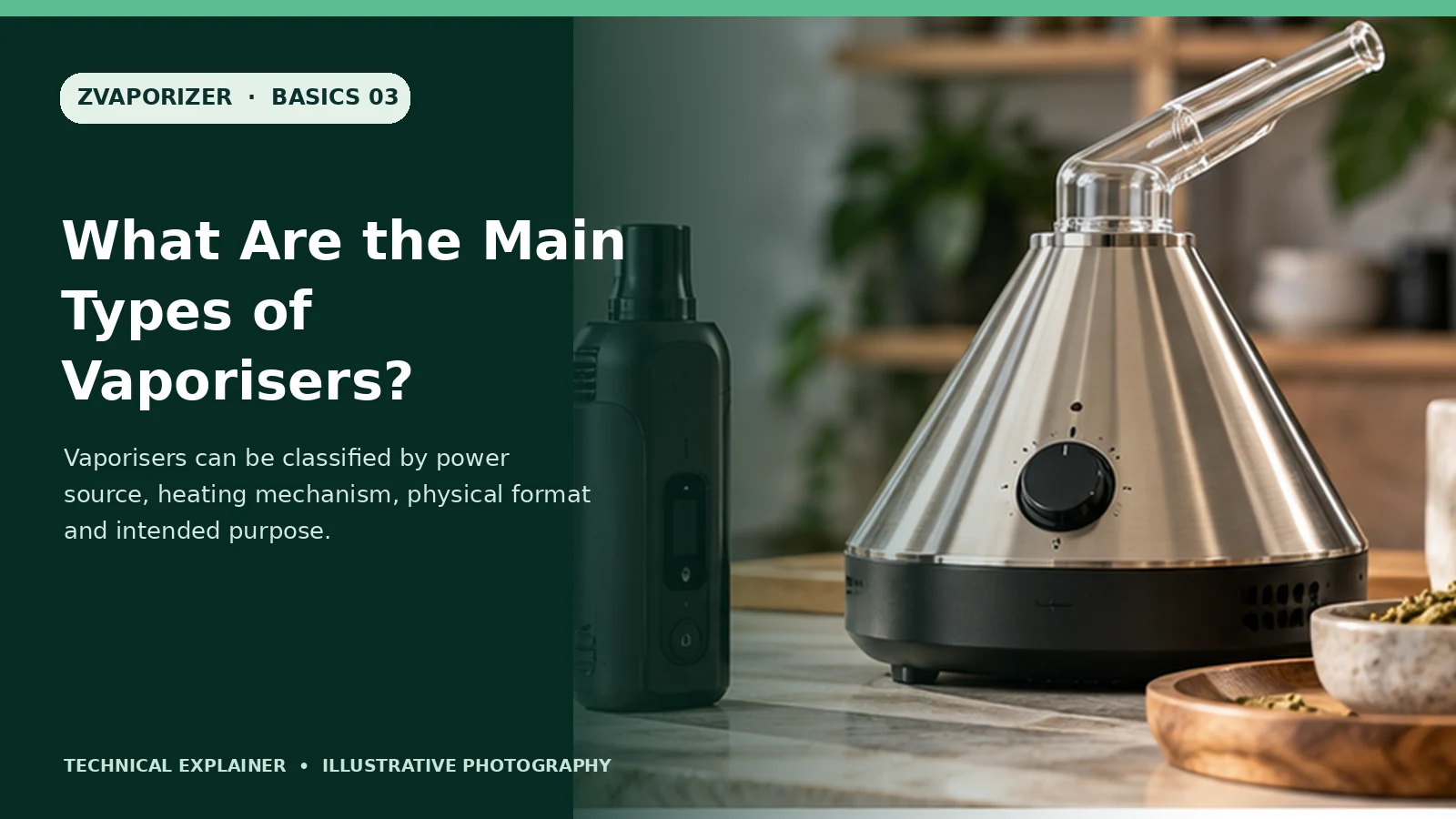
Vaporisers can be classified by power source, heating mechanism, physical format and intended purpose.
Classifying by format
Portable units generally combine their main components into a compact body. Desktop designs tend to operate from a fixed location and may use an external power supply. These labels help describe physical form; they do not reveal exact heater design or what a unit is intended to process.
Classifying by heat and power
A system can be electrically heated, externally heated or rely on another designed heat source. Electrically heated devices can use contact heating (conduction), heated airflow (convection) or a combination. Separate dimensions of classification can overlap: a portable unit can be convection-based, for instance. A battery-powered device is not automatically more or less temperature-accurate.
Classifying by intended use
A manufacturer may define equipment for a specific material or therapeutic purpose. The classification must follow that intended purpose and the product documentation, not only superficial features. The same housing shape is not sufficient evidence that two products accept the same material. Devices should not be repurposed on the assumption that all “vaporisers” work alike.
A practical example
Consider a compact battery-powered unit and a mains-powered desktop unit. Both may contain heaters and airflow paths, yet their power arrangements, heat-transfer details and instructions can differ. The useful comparison begins with the technical specification and intended use.
Three points to remember
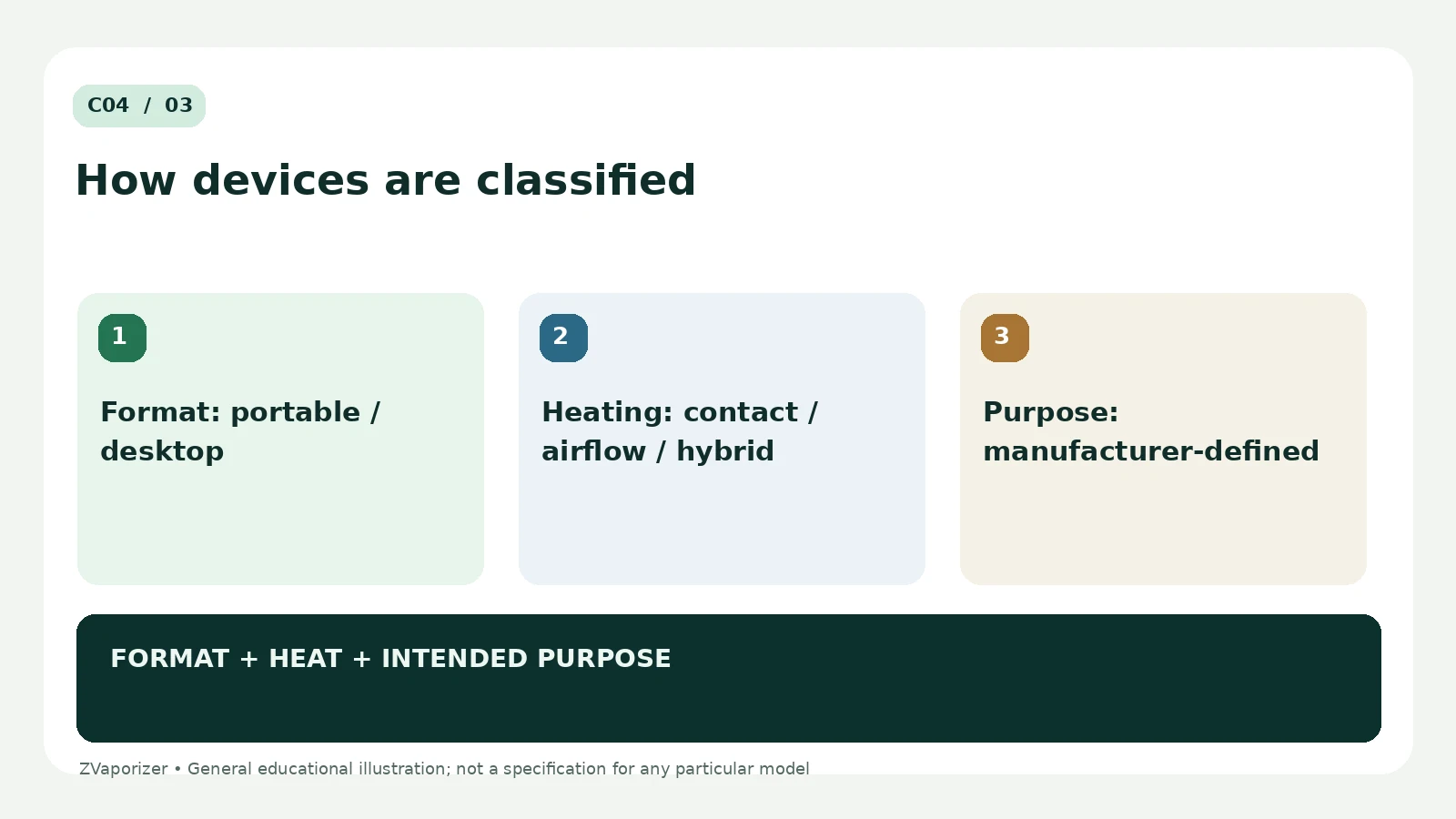
- Format: portable / desktop
- Heating: contact / airflow / hybrid
- Purpose: manufacturer-defined
Questions people often ask
Are all desktop units convection models?
No. Format and heat-transfer method are separate attributes.
Is a battery necessary for portable equipment?
Not always. Some compact designs use external heating.
Continue learning
- Vaporiser, Vape and Inhaler: Terminology Differences
- Portable vs Desktop Vaporisers: Basic Differences
- Vaporiser Basics: complete guide
- Vaporiser Technology & Engineering
Sources and further information
This article explains general terminology and engineering concepts. It does not establish the lawfulness, therapeutic suitability, or permitted advertising of any particular product in Australia. Refer to the specific manufacturer’s instructions and current official guidance.