Explore ZVaporizer collectionsAustralian product & device information
Start here · Essential knowledge

What Is a Vaporiser? Device Types, Parts and Common Terminology

Straightforward explanations of vaporiser terminology, device types and the technical vocabulary used in product documentation.

Topic collection C0424 articlesUpdated 9 October 2026

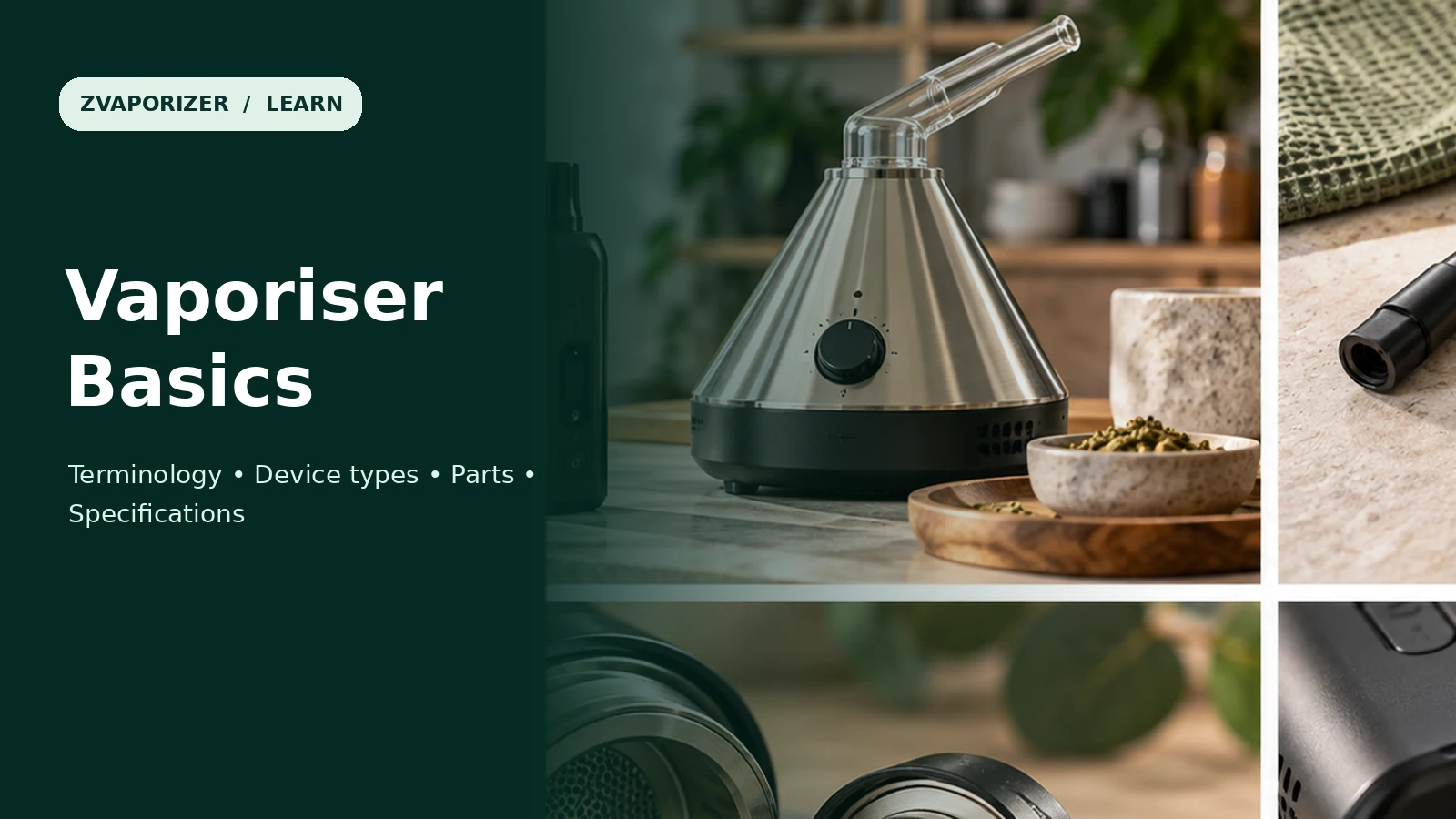
Portable and desktop device types introduced in the Vaporiser Basics guide
Portable and desktop device types introduced in the Vaporiser Basics guide.

A vaporiser (also spelled vaporizer) is a device designed to heat a substance so that components can enter a vapour or aerosol stream. The word covers a broad range of equipment, from industrial and medical equipment to handheld consumer products. Devices with similar names can have entirely different intended purposes, materials and regulatory classifications.

Vaporizer or vaporiser: which spelling is used in Australia?

Both spellings refer to the same general English word. Vaporiser uses the spelling more commonly associated with Australian and British English, while vaporizer is widely used in American English, international product names and web searches.

Brand or device names should retain their official spelling. In educational writing for Australian readers, either term may appear naturally, but spelling does not alter a product's legal classification.

What happens inside a vaporiser?

The simplest explanation is that a device delivers heat to a material. Heat may come from a powered element, an externally heated surface or another system. Volatile compounds and/or liquid droplets may then enter moving air and produce an aerosol.

Unlike a basic household kettle, an inhalation-related device may involve complex temperature, airflow and material-contact considerations. A visible cloud does not identify every substance present. Heating without an open flame does not make inhalation exposure free of risk.

A typical electrically heated system may involve a source of power, a control circuit, a heater, an area that receives the material and a route for air to travel through the device.

Learn more in How vaporiser technology works.

Common types of vaporiser design

Portable electronic systems

Portable units commonly combine a heater, rechargeable battery, control circuitry and a compact housing. Some use temperature displays, automatic shutdowns or other electronic features. The battery introduces particular charging and handling requirements.

Desktop systems

Desktop systems generally use an external power source and are designed for a fixed location. They can vary substantially in size, method of heating and air-path design. Larger size does not automatically establish medical suitability.

Externally heated systems

Some devices are heated with a separate external heat source rather than a built-in electric heating element. The absence of internal batteries changes the engineering design but does not remove hot-surface and misuse hazards.

Medical devices

A medical vaporising device is defined by its intended therapeutic purpose and applicable regulatory framework, not simply by a familiar housing shape. Australia's TGA assesses and regulates medical devices under distinct requirements. An ordinary product with a similar name should not be assumed equivalent to a registered medical device.

See Medical vaporising devices and the Australian Register of Therapeutic Goods.

Parts of a vaporiser: a plain-English glossary

TermMeaning
Heating elementComponent that generates heat.
ChamberArea designed to hold a material or interface with it.
Air inletOpening through which air enters a device.
Air pathRoute air follows through the assembly.
MouthpieceOutlet component on some device types.
Temperature sensorComponent used to measure temperature at a defined location.
ControllerElectronics or mechanism managing device functions.
Seal or gasketComponent intended to restrict leaks or maintain fit.
Filter or screenComponent designed for a specific filtration or retention role.
Battery management systemCircuitry that helps control and protect a rechargeable battery.
USB-CA connector format, not a guarantee that any charger is suitable.
ARTGAustralian Register of Therapeutic Goods.
The wording used in a manufacturer's official manual is the best reference for that model. A part with the same general name can differ significantly between devices.

What do conduction and convection mean?

Conduction is heat transfer through direct contact. Convection is heat transfer through moving air or another fluid. Some designs combine both, often called hybrid heating.

These words describe mechanisms, not health outcomes. The way a device controls temperature, moves air and manages heat loss can be just as important as the label applied to its heater.

For a deeper explanation, see Heating, airflow and temperature control.

Vapour, aerosol and smoke: are they the same thing?

Not exactly. Vapour is a gas-phase form of a substance. An aerosol contains fine liquid droplets or solid particles suspended in gas. Smoke usually refers to airborne material produced by combustion or thermal decomposition, although everyday descriptions are less precise.

A device marketed as producing “vapour” can generate an aerosol containing multiple compounds. The visible appearance of the output alone does not establish what it contains or whether inhalation is safe.

A product's intended material matters as much as its hardware. Oils, liquids and dried materials are not universally interchangeable. A substance must not be used with a device merely because it physically fits.

Understanding temperature and battery specifications

Technical specifications are helpful only when interpreted correctly.

A temperature range may describe a controller target rather than the exact temperature everywhere in the chamber. A battery-capacity figure indicates a nominal electrical characteristic, not guaranteed runtime. Charging-port type does not prove compatibility with every charger or power adapter.

Where a device is designed for medical use, the instructions for use and approved intended purpose are more important than generic comparison claims.

Safety and responsible interpretation

Hot elements can burn skin; incorrectly charged or damaged batteries can fail; and worn or substituted components may affect the intended functioning of a device. Follow original manufacturer documentation and stop using any device that shows signs of damage or unusual operation.

Fire and Rescue NSW provides practical advice about battery charging, storage and disposal. Read the device safety and maintenance guide for further information.

Australian rules can depend on intended purpose

Australia regulates vaping goods under a framework that is not limited to nicotine. The status of an object called a “dry herb vaporiser” or “accessory” cannot be established solely from its product label. Medicinal cannabis devices can also fall under medical-device and import controls.

For the current national framework, see Vaporiser laws in Australia and the TGA's vaping guidance.

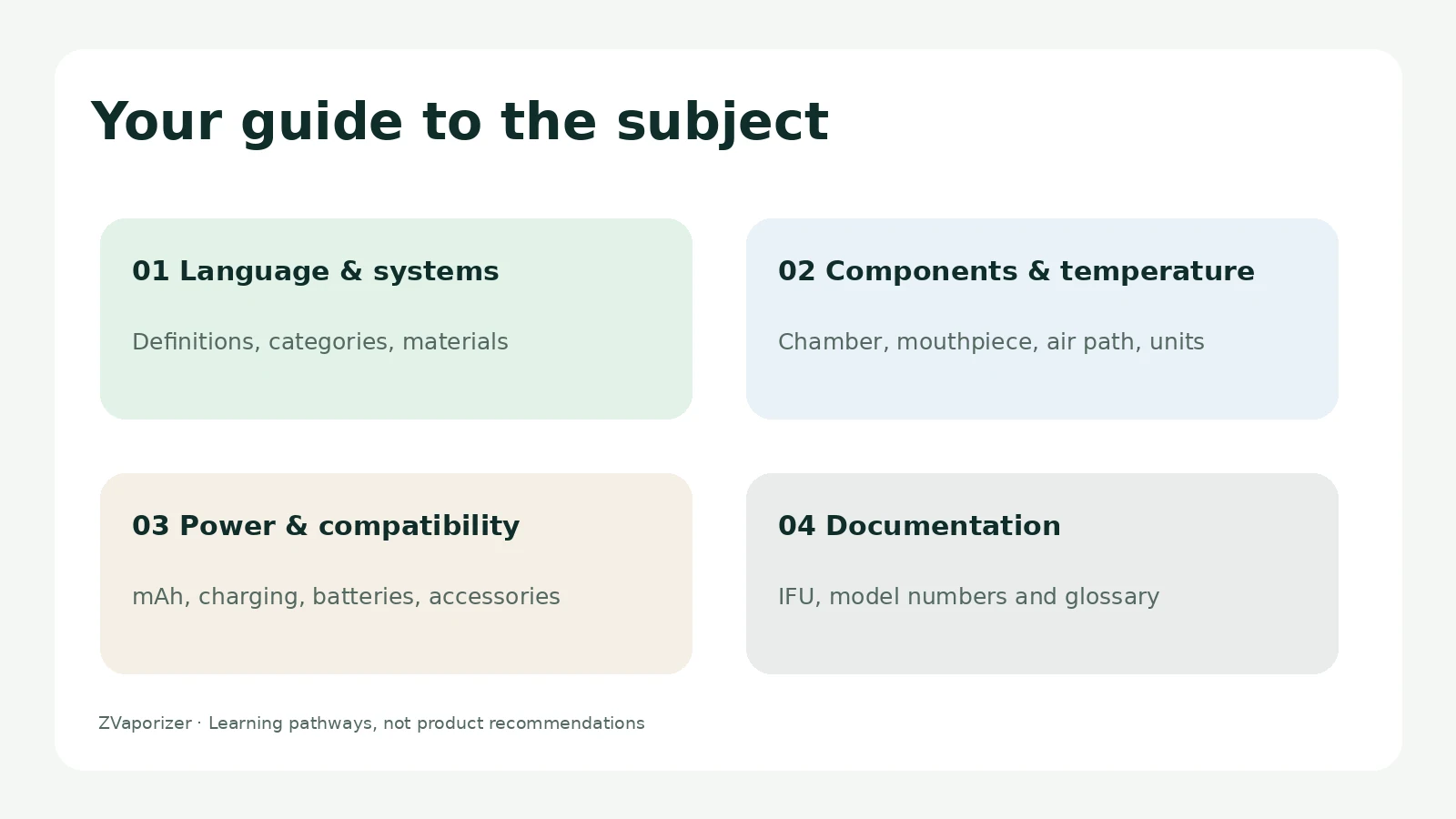
Four learning sections in the ZVaporizer Basics topic hub
Four learning sections in the ZVaporizer Basics topic hub.

This page explains terminology and general technology; it does not recommend a vaping product or provide medical advice.

Explore Vaporiser Basics

Read focused articles on the topics covered by this collection. Each article has its own permanent URL and links back to this guide.

Further reading

Articles in this collection

24 focused articles

Vaporiser Basics

Frequently Asked Questions About Vaporiser Terminology

Start with the manufacturer’s model number and intended-use statement. Then read the manual’s description of the heat source, material holder, power requirements and maintenance boundaries. A headline like “portable vaporiser” is only a starting point.

Read article
Vaporiser Basics

Vaporiser Acronyms and Abbreviations A–Z

AC means alternating current; DC means direct current. USB-C is a connector type; USB PD means USB Power Delivery. BMS stands for battery management system. mAh refers to milliamp-hours, a measure of electric charge, while Wh means watt-hours, a measure of energy. These terms should not be used interchangeably.

Read article
Vaporiser Basics

Why Manufacturer Documentation Matters

A headline rating may depend on operating conditions, a particular test method or a hardware revision. Manufacturer documents should explain the unit, test boundary and any limitations. Unverified review numbers and general shopping descriptions can omit these details.

Read article
Vaporiser Basics

What Is an Instruction for Use (IFU)?

For a medical device, IFU is a formal term for manufacturer information supplied to the intended user about safe use for its intended purpose. An IFU may include setup, warnings, user qualifications, contraindications, cleaning, storage and fault responses. Ordinary electronic devices may instead use the terms user manual or operating instructions.

Read article
Vaporiser Basics

Open and Closed Systems: Device Classification Basics

A closed system often uses sealed or proprietary consumable modules intended to be replaced as a whole. This can limit which parts a user handles, but it does not guarantee the contents, safety or permitted purpose. The word closed can also refer to a sealed electrical enclosure in a different engineering context.

Read article
Vaporiser Basics

What Is a Removable Battery System?

A removable-battery device is designed with a battery compartment, contacts and authorised cell specifications. This is different from a built-in battery that a technician might access by disassembling the housing. A compartment door is not permission to substitute any battery of similar shape.

Read article
Vaporiser Basics

Device Accessories: Common Types and Terms

Manufacturers may offer carrying cases, cleaning brushes, power adaptors, storage containers, seals, screens, outlet components and replacement fittings. Some are purely protective; others form part of the air pathway or electrical system. A case and a heating insert therefore have very different engineering roles.

Read article
Vaporiser Basics

How to Read a Device Model Number

Model numbers may appear on a rating plate, original packaging, manufacturer portal, instructions or a product label. Serial numbers usually distinguish individual units, while a model number identifies a family or configuration. Hardware revision or regional suffixes may change parts compatibility.

Read article
Vaporiser Basics

What Does Charging Time Mean in Specifications?

A specification may state approximate time from a low-charge condition to full charge with a named charger. Real charging involves different current stages and may slow near full capacity. The starting charge, temperature, battery age, firmware and supported charging protocol all affect elapsed time.

Read article
Vaporiser Basics

Understanding Battery Capacity and mAh

A battery rated 3,000 mAh is nominally 3 Ah of charge capacity under specified test conditions. Actual operating time depends on load, temperature, cell condition, cut-off rules and controller behaviour. An energy-intensive heater behaves differently from a low-power display even if both use a similar cell.

Read article
Vaporiser Basics

Understanding Device Size, Weight and Dimensions

Specifications may list height, width and depth, commonly in millimetres in Australian publications. Manufacturers may describe orientation differently, so compare diagrams instead of relying only on an order of numbers. External dimensions may exclude protruding mouthpieces, chargers, cables or optional fittings.

Read article
Vaporiser Basics

What Does Temperature Range Mean on a Specification Sheet?

A published range may describe available controller targets, sensor readings, or normal operating boundaries. The endpoints indicate what the manufacturer is claiming about an adjustable system; they do not automatically describe uniform material temperature. A specification without measurement conditions is less informative than one that identifies sensor position and tolerance.

Read article
Vaporiser Basics

Understanding Device Temperature Units: Celsius and Fahrenheit

A temperature display without a visible unit can be confusing. Australian documentation usually favours degrees Celsius (°C). Some international devices or manuals use Fahrenheit (°F). The numbers are not directly interchangeable: a numerical value that looks similar can represent a very different temperature.

Read article
Vaporiser Basics

What Is a Vapour Path?

A simplified route may begin at an air inlet, pass through a heated region, continue along a channel and end at an outlet. Actual designs include branches, valves or removable tubing. The word path does not imply that all air passes through a single easily visible tube.

Read article
Vaporiser Basics

What Is a Mouthpiece? A Device Terminology Guide

In some devices a mouthpiece is the final component in an air or aerosol pathway. It may include a narrow channel, seal or removable tip. In others the outlet connects to separate tubing. The term describes where the flow leaves the device rather than how the heater works.

Read article
Vaporiser Basics

What Is a Heating Chamber?

Geometry, wall thickness, contact area and airflow influence how heat moves through a chamber. Two chambers of identical volume can behave differently because their materials, heater positions and surrounding insulation are not the same. The word chamber describes function, not a guaranteed temperature uniformity.

Read article
Vaporiser Basics

Vaporiser Parts Explained for Beginners

The electrical system supplies and regulates energy. A battery or power supply feeds the control electronics and heater. Temperature sensors or protective devices may be installed near the heating assembly. The precise location is model-specific, and drawings of a generic device should not be interpreted as a repair manual.

Read article
Vaporiser Basics

Vapour, Aerosol and Smoke: What the Terms Mean

Vapour refers to the gas phase of a substance under stated conditions. A gas-phase component can be invisible. Everyday speech often calls a visible cloud “vapour” even when much of that cloud is an aerosol of condensed droplets. Marketing vocabulary is therefore less precise than scientific terminology.

Read article
Vaporiser Basics

What Is an Electronic Heating Device?

A heater has electrical resistance. When current flows, electrical energy is converted to heat. A controller may regulate the current or switch power to maintain a target condition. This is a broad engineering principle shared by many household products; it does not describe an inhalation purpose on its own.

Read article
Vaporiser Basics

What Is a Dry Herb Vaporiser?

Dry herb describes a type of material rather than a performance standard. Devices associated with this term commonly include a chamber, a heater and a route for air or aerosol to pass through. Chamber shape, heat delivery and operating limits differ by model. A dry-herb label does not by itself establish which particular botanical material can be used safely or lawfully.

Read article
Vaporiser Basics

Portable vs Desktop Vaporisers: Basic Differences

Portable devices place the heater, controls and other necessary parts into a small enclosure. Battery-operated models introduce runtime and charging considerations. Compact designs can require careful control of temperature near the casing and at the air path. Weight may matter, but weight alone cannot predict performance.

Read article
Vaporiser Basics

What Are the Main Types of Vaporisers?

Portable units generally combine their main components into a compact body. Desktop designs tend to operate from a fixed location and may use an external power supply. These labels help describe physical form; they do not reveal exact heater design or what a unit is intended to process.

Read article
Vaporiser Basics

Vaporiser, Vape and Inhaler: Terminology Differences

A vaporiser is a device that produces a vapour or aerosol through a designed physical process. In everyday retail language it often refers to a compact heated device. In engineering, however, the same general word can describe quite different apparatus. The operating principle and intended material are essential context.

Read article
Vaporiser Basics

Vaporizer vs Vaporiser: Australian and US Spelling

Vaporiser is the spelling commonly seen in Australian and British English. Vaporizer is more familiar in US English and appears in many international product names. Neither spelling defines a separate category of equipment. In Australia you will encounter both because product packaging, manuals and brand websites frequently arrive from overseas. A reader may even find “vaporiser” in an Australian guide and “vaporizer” on the manufacturer’s carton.

Read article

Frequently asked questions

Is a vaporiser the same as an e-cigarette?

The words overlap in some conversations but are not technically or legally identical in every context. Always consider the type of device, substance and intended purpose.

Are portable and desktop vaporisers fundamentally different?

Both use heat-transfer principles, but they may differ in power supply, size, components, thermal design and intended use.

Is a vaporiser with a digital display more accurate?

A display provides information from the device's control system. Accuracy depends on sensor design, calibration and measurement location.

Are all dry herb devices medical devices?

No. Medical-device status is linked to the device's intended therapeutic purpose and regulatory classification, not merely its shape or heating method.

Does “herbal” mean a product is safe or unregulated?

No. Product safety and legality cannot be concluded from that label alone.

Can accessories be used across different brands?

Only where compatibility is established by the manufacturer or appropriate documentation. Similar-looking components may have different specifications.

Official sources and further reading

  1. TGA — Changes to the regulation of vapes
  2. TGA — About medical devices
  3. TGA — Medical cannabis vaping devices information
  4. Fire and Rescue NSW — Battery and charging safety

Your cart 0