
In this article
Reading a displayed numberConvert the units correctlyWhy the setting may not equal the material temperatureA practical exampleThree points to rememberQuestions people often askDoes changing display units alter heating hardware?Is 100°C a recommended setting?Continue learningSources and further informationRelated articles
Celsius and Fahrenheit are two scales for expressing temperature; specifications must state which scale is in use.
Reading a displayed number
A temperature display without a visible unit can be confusing. Australian documentation usually favours degrees Celsius (°C). Some international devices or manuals use Fahrenheit (°F). The numbers are not directly interchangeable: a numerical value that looks similar can represent a very different temperature.
Convert the units correctly
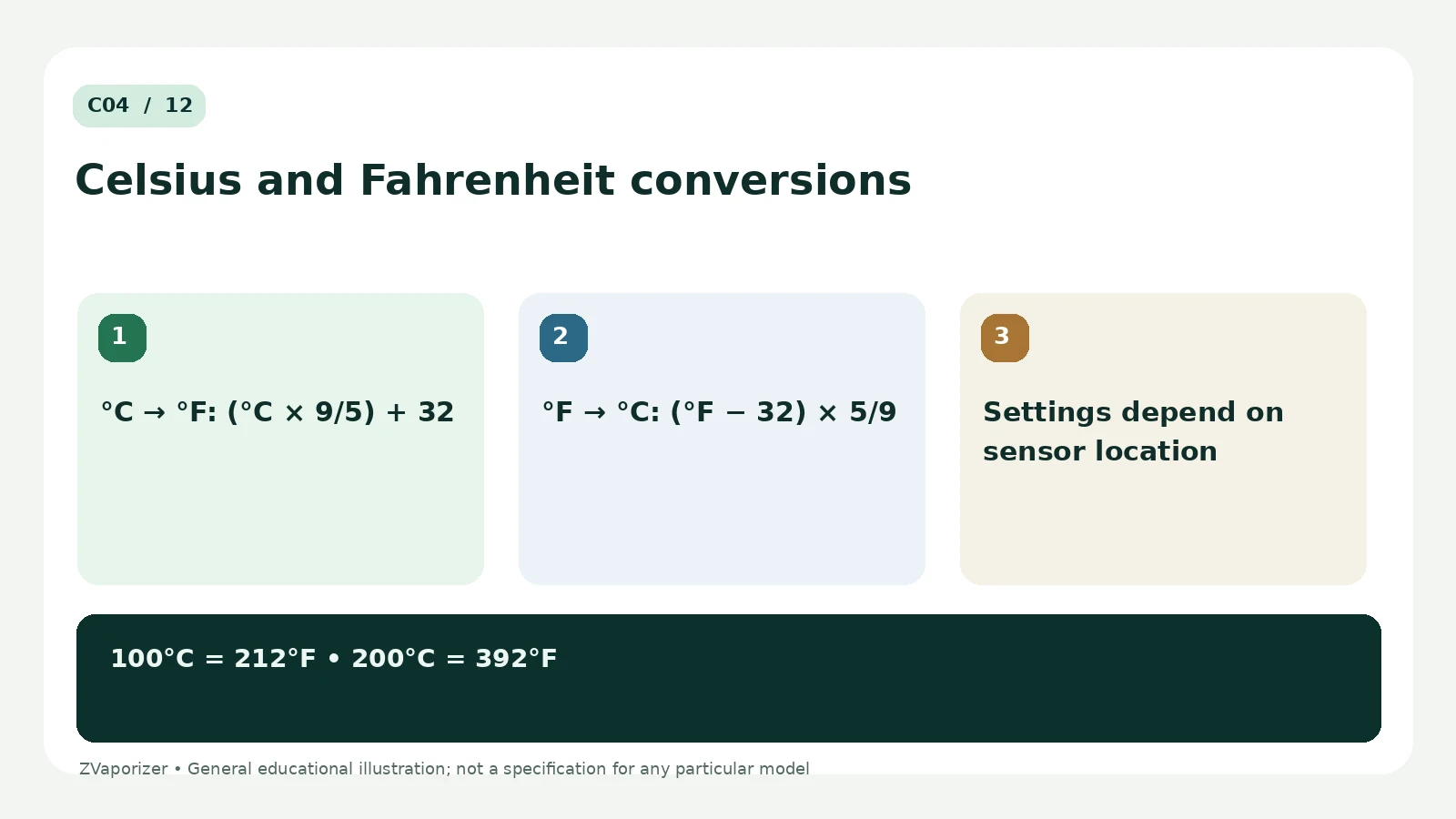
To convert Celsius to Fahrenheit, multiply by 9/5 and add 32. To convert Fahrenheit to Celsius, subtract 32 and multiply by 5/9. As simple examples, 100°C equals 212°F and 200°C equals 392°F. These are unit conversions only, not device operating recommendations.
Why the setting may not equal the material temperature
On a controlled heater, the indicated value may come from a sensor near the heating element, a chamber-wall reading, or a controller target. It does not prove that every surface is at the displayed temperature. When comparing two models, look for the manufacturer’s measurement definition and stated accuracy.
A practical example
A manual written for another market shows 392°F. That is 200°C, not 392°C. Converting before interpreting a specification avoids a major numerical misunderstanding.
Three points to remember
- °C → °F: (°C × 9/5) + 32
- °F → °C: (°F − 32) × 5/9
- Settings depend on sensor location
Questions people often ask
Does changing display units alter heating hardware?
Usually the display changes representation of the target, but confirm the manual.
Is 100°C a recommended setting?
No. It is simply a round example for illustrating conversion.
Continue learning
- What Is a Vapour Path?
- What Does Temperature Range Mean on a Specification Sheet?
- Vaporiser Basics: complete guide
Sources and further information
This article explains general terminology and engineering concepts. It does not establish the lawfulness, therapeutic suitability, or permitted advertising of any particular product in Australia. Refer to the specific manufacturer’s instructions and current official guidance.