
In this article
Common accessory groupsCompatibility must be exactRegulatory language matters in AustraliaA practical exampleThree points to rememberQuestions people often askIs an accessory always optional?Can I use any similarly sized part?Continue learningSources and further informationRelated articles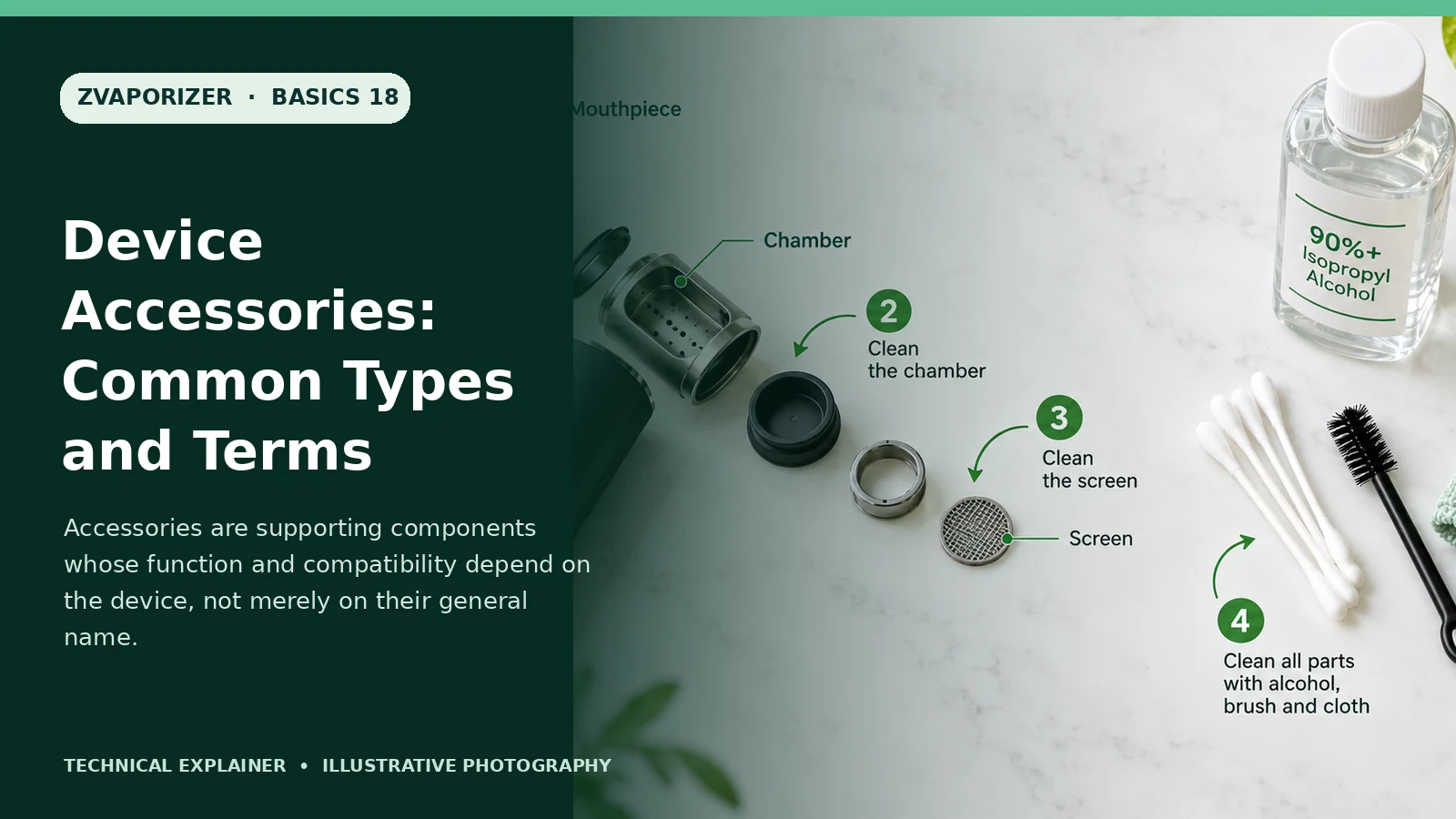
Accessories are supporting components whose function and compatibility depend on the device, not merely on their general name.
Common accessory groups
Manufacturers may offer carrying cases, cleaning brushes, power adaptors, storage containers, seals, screens, outlet components and replacement fittings. Some are purely protective; others form part of the air pathway or electrical system. A case and a heating insert therefore have very different engineering roles.
Compatibility must be exact
Dimensions alone rarely prove suitability. A seal may need a specified polymer, and a charger must match electrical requirements. A third-party screen or mouthpiece might alter flow resistance. Use the model-specific part number and official fitting instructions wherever available.
Regulatory language matters in Australia
An accessory for a regulated vaping device may itself fall within the definitions of vaping goods or medical-device accessories. Its label as an “accessory” does not establish permission to advertise or supply it publicly. Consult Australian regulatory information for the relevant framework.
A practical example
Two mouthpiece inserts share the same external diameter but different seals. A generic listing that says “fits many devices” is less reliable than a manufacturer compatibility list including model revisions.
Three points to remember
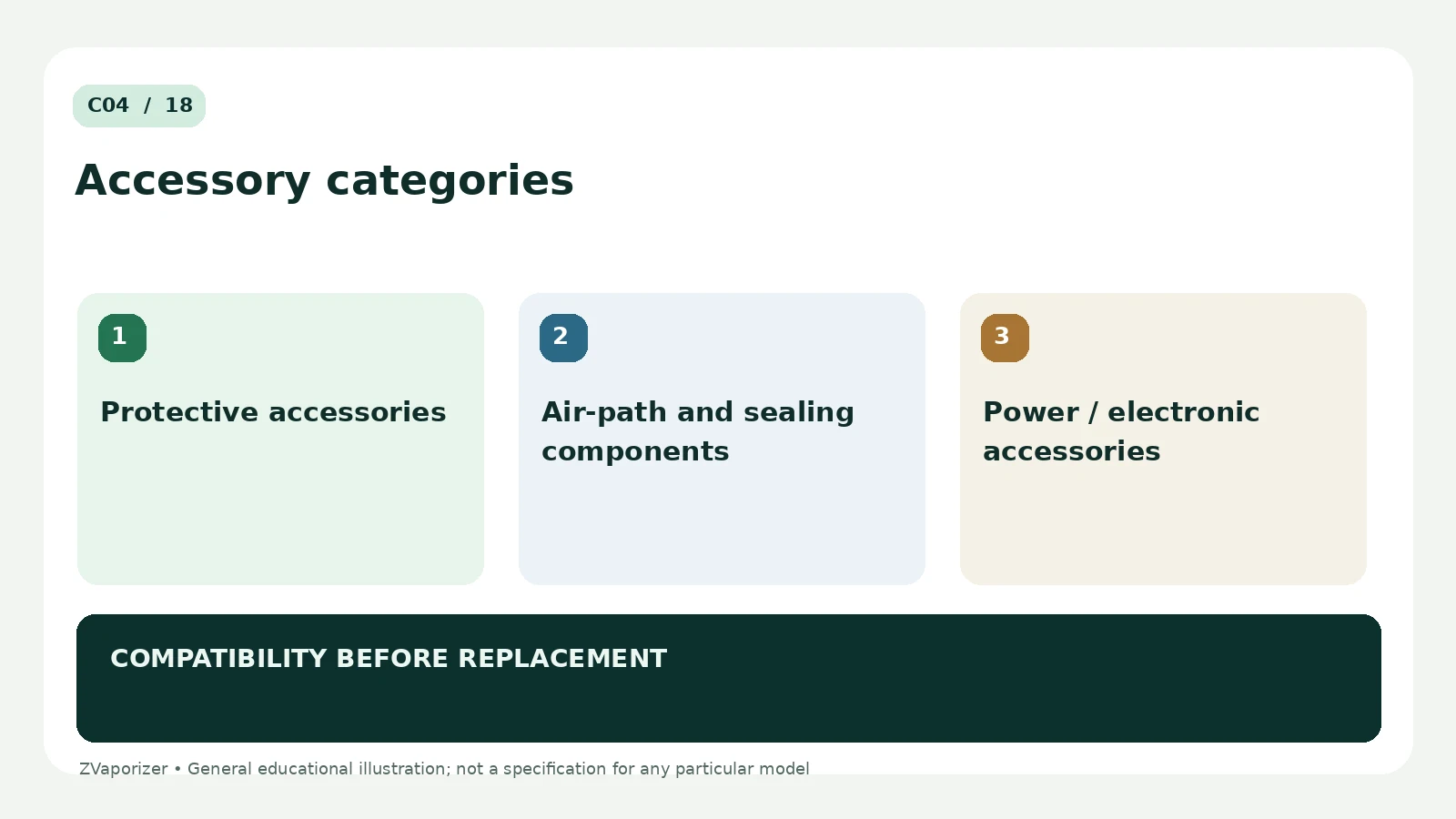
- Protective accessories
- Air-path and sealing components
- Power / electronic accessories
Questions people often ask
Is an accessory always optional?
No. Some accessories are needed for intended operation.
Can I use any similarly sized part?
No. Match specifications and manufacturer approval.
Continue learning
- How to Read a Device Model Number
- What Is a Removable Battery System?
- Vaporiser Basics: complete guide
- Australian Laws & Regulations
Sources and further information
This article explains general terminology and engineering concepts. It does not establish the lawfulness, therapeutic suitability, or permitted advertising of any particular product in Australia. Refer to the specific manufacturer’s instructions and current official guidance.