
In this article
Vapour in scientific languageAerosol is about suspended particlesSmoke is not simply the opposite of vapourA practical exampleThree points to rememberQuestions people often askIs visible vapour always pure gas?Does absence of smoke mean safe to inhale?Continue learningSources and further informationRelated articles
Vapour is gas-phase material; aerosol is particles or droplets suspended in gas; smoke is a type of aerosol often associated with combustion or decomposition.
Vapour in scientific language
Vapour refers to the gas phase of a substance under stated conditions. A gas-phase component can be invisible. Everyday speech often calls a visible cloud “vapour” even when much of that cloud is an aerosol of condensed droplets. Marketing vocabulary is therefore less precise than scientific terminology.
Aerosol is about suspended particles
IUPAC describes an aerosol as a system containing solid particles, liquid droplets or both dispersed in gas. The appearance of an aerosol depends on particle size, illumination and composition. A cloud that looks thin is not necessarily made of a single substance or free of particles. Laboratory sampling is required to characterise its constituents.
Smoke is not simply the opposite of vapour
Smoke is a form of aerosol associated with combustion, thermal decomposition or related high-temperature processes. The boundaries can be chemically complicated: heating can produce aerosols without an obvious flame, and some decomposition products may still appear. These words describe physical phenomena, not a simple ranking of health risks.
A practical example
Steam above a kettle is commonly called “water vapour”; the visible white portion mainly consists of tiny condensed liquid droplets suspended in air. This helps explain why what we see may not be identical to an invisible gas.
Three points to remember
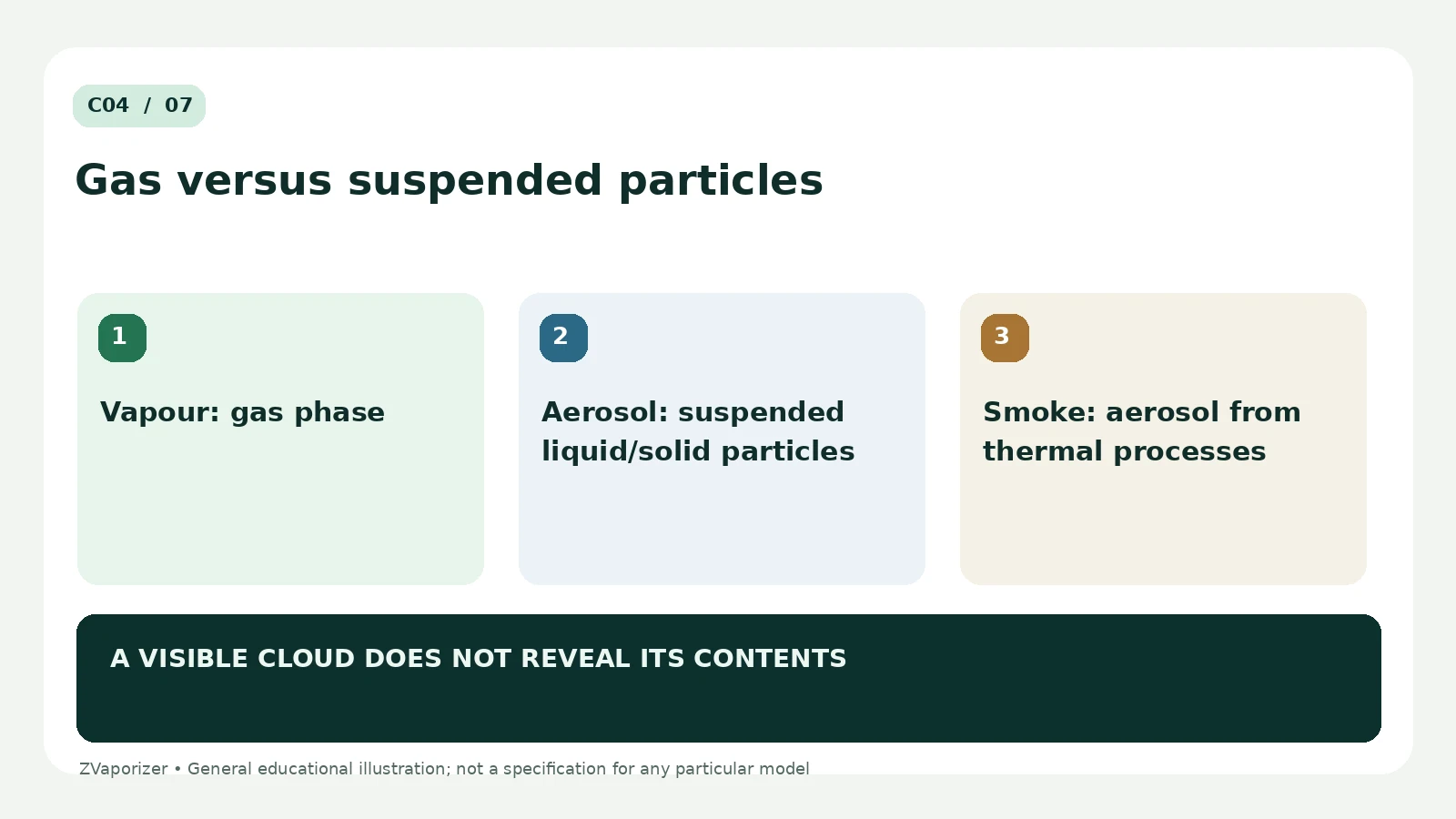
- Vapour: gas phase
- Aerosol: suspended liquid/solid particles
- Smoke: aerosol from thermal processes
Questions people often ask
Is visible vapour always pure gas?
No. Visible clouds often include condensed droplets or other aerosol particles.
Does absence of smoke mean safe to inhale?
No. Appearance alone cannot establish composition or safety.
Continue learning
- What Is an Electronic Heating Device?
- Vaporiser Parts Explained for Beginners
- Vaporiser Basics: complete guide
- Vaporiser Technology & Engineering
Sources and further information
This article explains general terminology and engineering concepts. It does not establish the lawfulness, therapeutic suitability, or permitted advertising of any particular product in Australia. Refer to the specific manufacturer’s instructions and current official guidance.