
In this article
How manufacturers estimate charging timeConnector versus charging capabilityWhat to watch for in normal useA practical exampleThree points to rememberQuestions people often askDoes a stronger charger always charge faster?Can a cable affect charging time?Continue learningSources and further informationRelated articles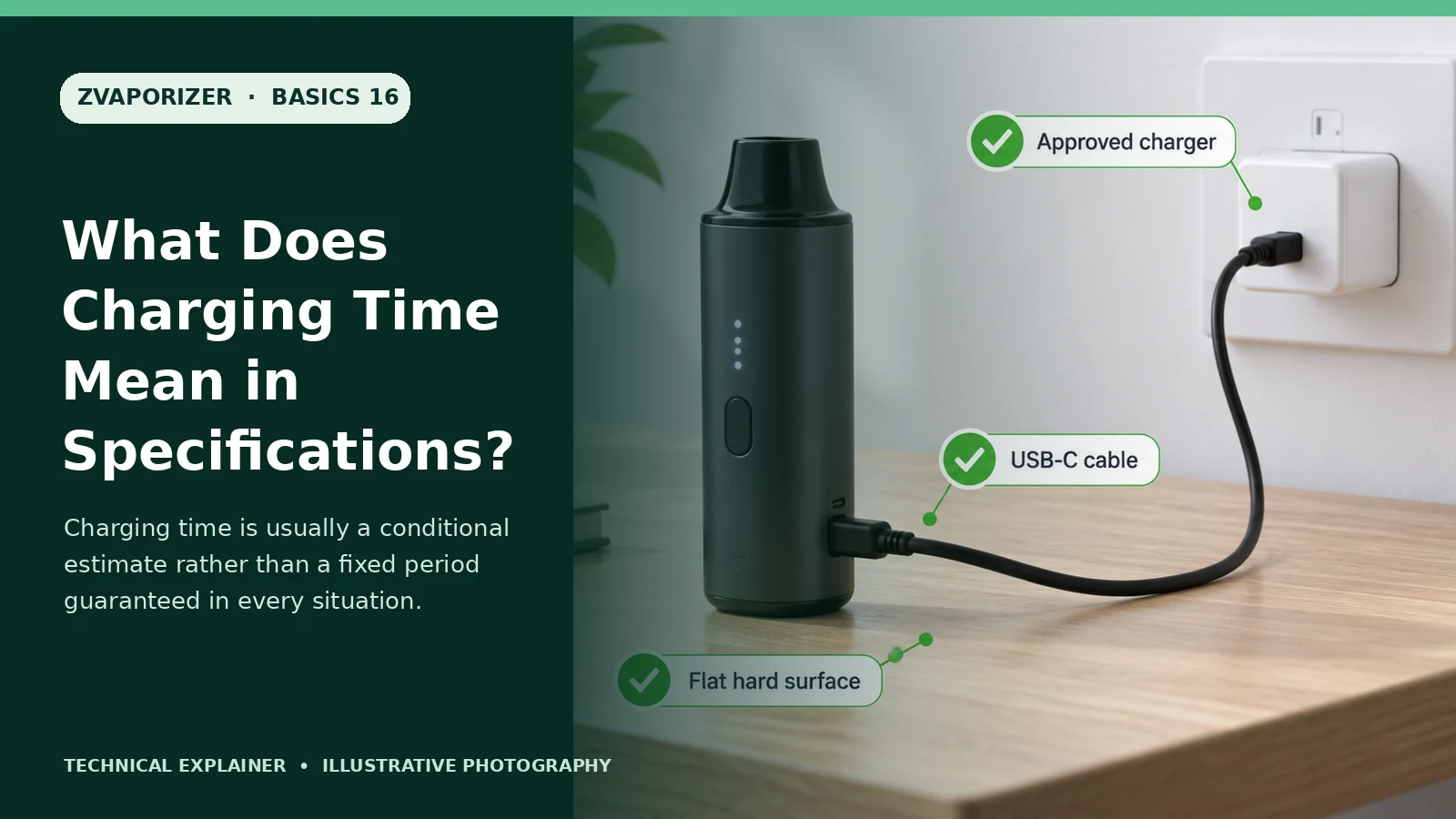
Charging time is usually a conditional estimate rather than a fixed period guaranteed in every situation.
How manufacturers estimate charging time
A specification may state approximate time from a low-charge condition to full charge with a named charger. Real charging involves different current stages and may slow near full capacity. The starting charge, temperature, battery age, firmware and supported charging protocol all affect elapsed time.
Connector versus charging capability
A USB-C socket describes the connector shape. It does not establish that a device supports USB Power Delivery or every adaptor power profile. USB-IF distinguishes Type-C from the Power Delivery standard. The manufacturer’s stated input ratings and supplied or approved charger determine the intended combination.
What to watch for in normal use
An unexpectedly long charging time might reflect a weak cable, unsuitable adaptor, temperature protection or deteriorating battery. Do not keep trying random chargers on a device that becomes abnormally hot, swells or smells unusual. Follow safety instructions and seek qualified support when behaviour changes.
A practical example
One model charges in “about 90 minutes” using a specified adaptor, but takes longer on a low-output computer port. This variation does not prove a fault unless it falls outside the conditions and tolerances in the instructions.
Three points to remember
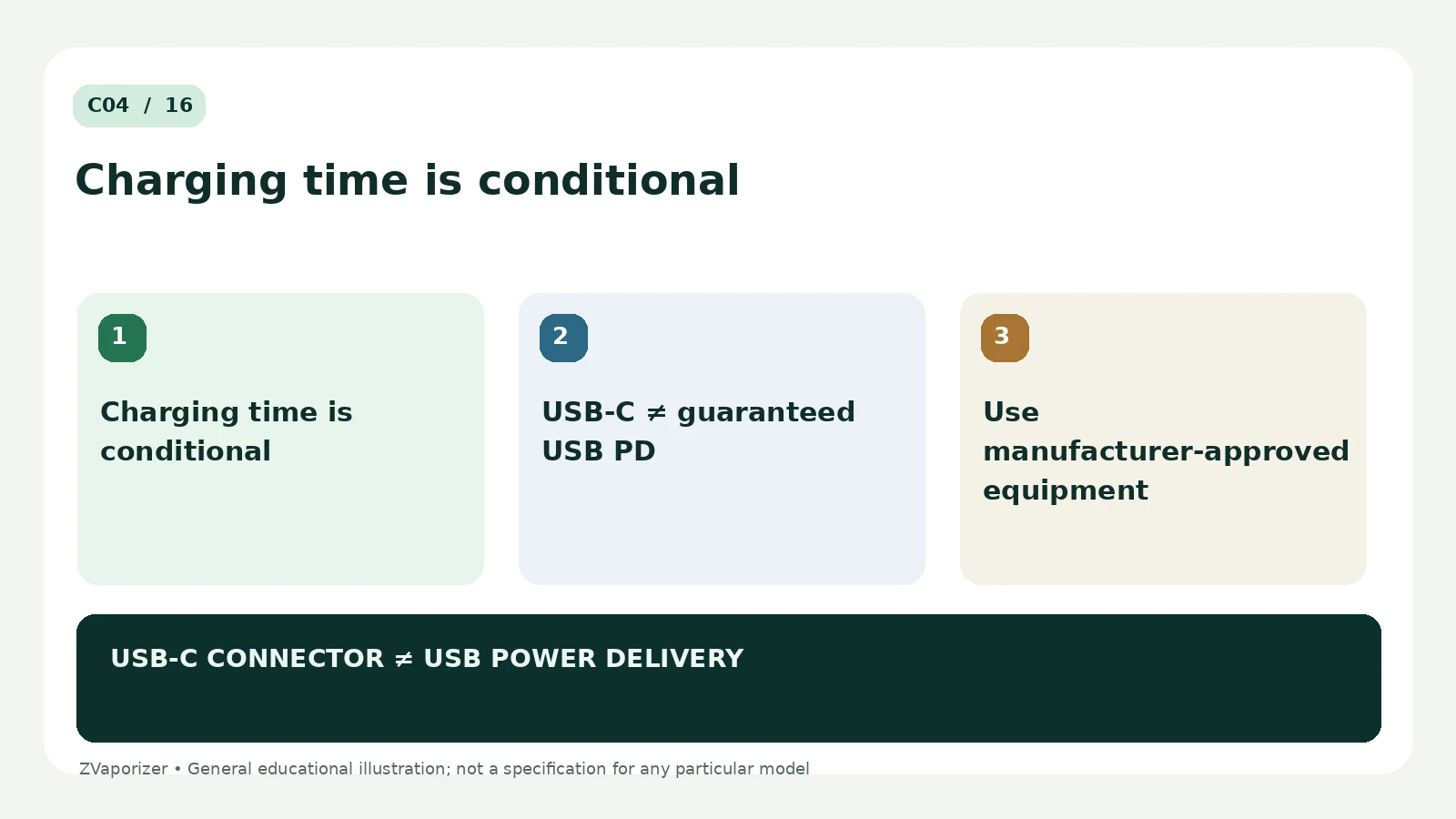
- Charging time is conditional
- USB-C ≠ guaranteed USB PD
- Use manufacturer-approved equipment
Questions people often ask
Does a stronger charger always charge faster?
No. The device controls supported input and protective limits.
Can a cable affect charging time?
Yes. Cable condition and capability can matter.
Continue learning
- Understanding Battery Capacity and mAh
- How to Read a Device Model Number
- Vaporiser Basics: complete guide
- Device Safety & Maintenance
Sources and further information
- USB-IF — USB Type-C information
- CSIRO & ACCC — Lithium-ion battery safety report
- ACCC Product Safety — Lithium-ion batteries guide
This article explains general terminology and engineering concepts. It does not establish the lawfulness, therapeutic suitability, or permitted advertising of any particular product in Australia. Refer to the specific manufacturer’s instructions and current official guidance.