
In this article
mAh measures charge, not minutesWhy watt-hours can helpCapacity is not the same as suitabilityA practical exampleThree points to rememberQuestions people often askDoes mAh equal battery life in hours?Can I fit a higher-mAh battery?Continue learningSources and further informationRelated articles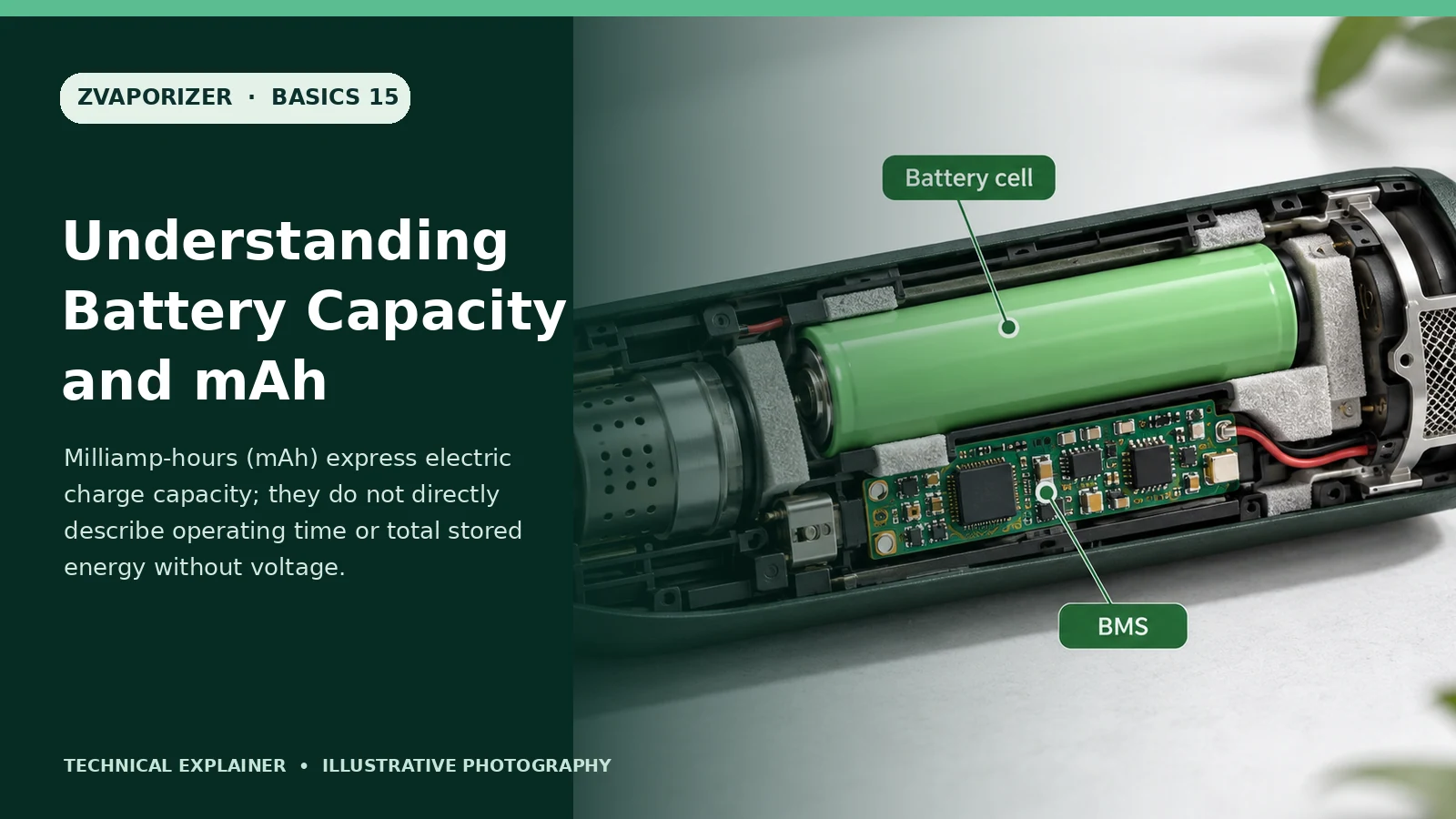
Milliamp-hours (mAh) express electric charge capacity; they do not directly describe operating time or total stored energy without voltage.
mAh measures charge, not minutes
A battery rated 3,000 mAh is nominally 3 Ah of charge capacity under specified test conditions. Actual operating time depends on load, temperature, cell condition, cut-off rules and controller behaviour. An energy-intensive heater behaves differently from a low-power display even if both use a similar cell.
Why watt-hours can help
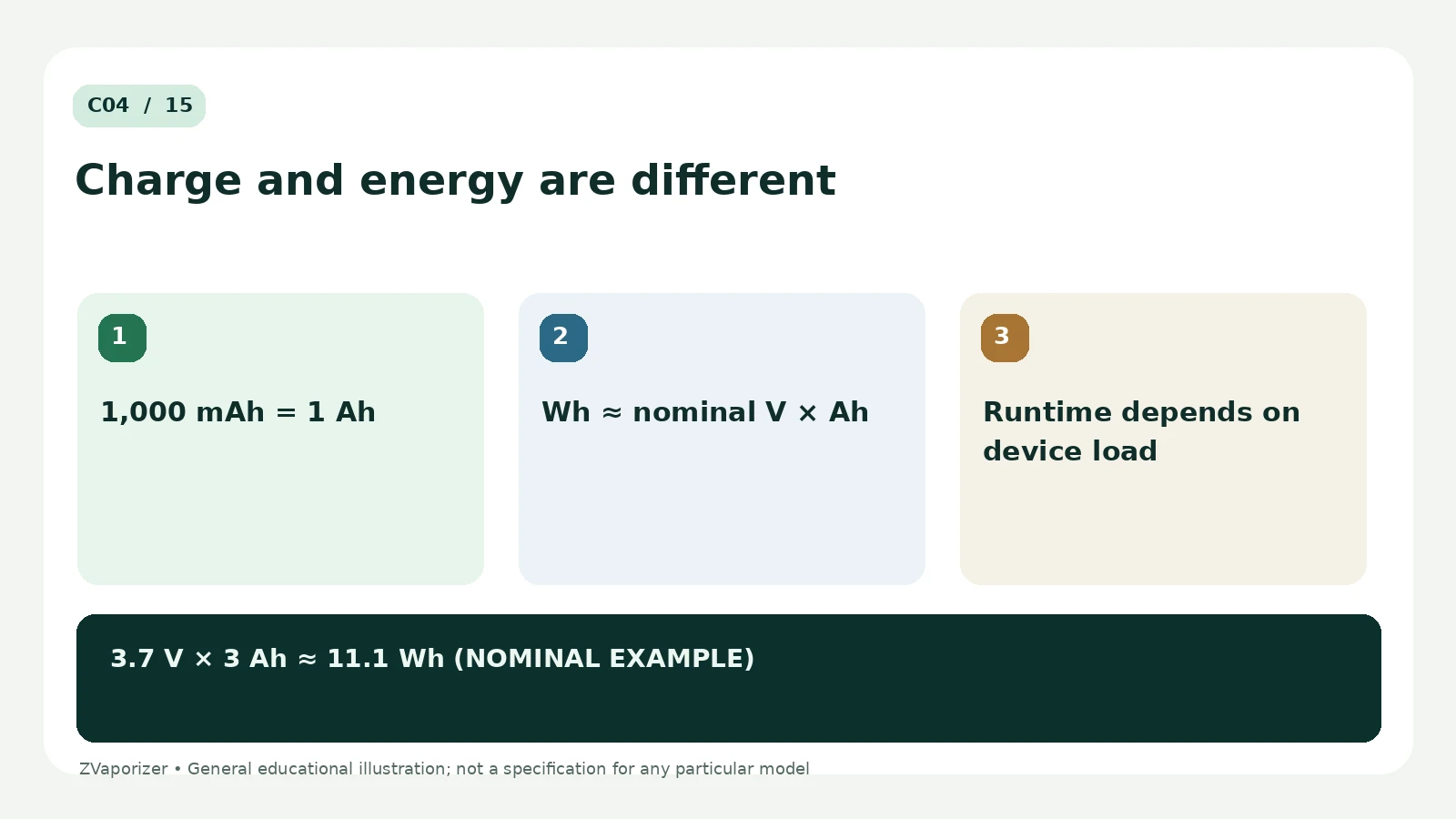
Energy can be approximated in watt-hours using nominal voltage times amp-hours: Wh ≈ V × Ah. For example, a nominal 3.7 V, 3 Ah cell has about 11.1 Wh of nominal energy. That calculation is educational; it does not predict the exact usable amount in a complete device. Battery specifications should be supplied by the manufacturer.
Capacity is not the same as suitability
Cell dimensions, chemistry, discharge current, protection circuitry and temperature ratings also matter. A battery labelled with a larger mAh figure is not automatically a compatible replacement. Swapping cells on the basis of capacity alone can be dangerous. Only user-replaceable cells specified in the manual should be considered.
A practical example
A brochure gives 2,500 mAh and another gives 3,000 mAh. Without information on voltage, power consumption and conditions, the second device cannot be assumed to operate 20% longer.
Three points to remember
- 1,000 mAh = 1 Ah
- Wh ≈ nominal V × Ah
- Runtime depends on device load
Questions people often ask
Does mAh equal battery life in hours?
No. It is charge capacity; consumption determines runtime.
Can I fit a higher-mAh battery?
Only if the exact replacement is approved for the model and user-serviceable.
Continue learning
- Understanding Device Size, Weight and Dimensions
- What Does Charging Time Mean in Specifications?
- Vaporiser Basics: complete guide
- Device Safety & Maintenance
Sources and further information
This article explains general terminology and engineering concepts. It does not establish the lawfulness, therapeutic suitability, or permitted advertising of any particular product in Australia. Refer to the specific manufacturer’s instructions and current official guidance.